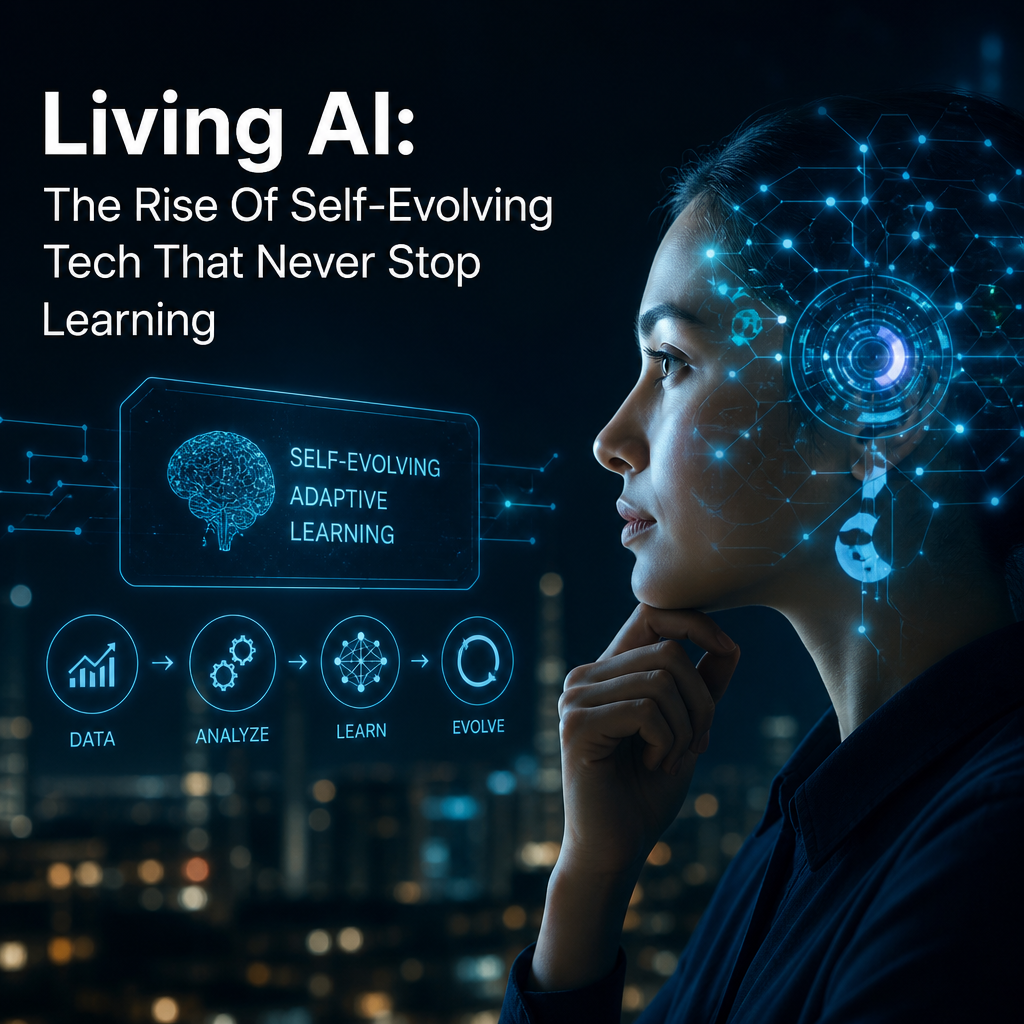
Living AI: The Rise Of Self-Evolving Tech That Never Stops Learning
Once upon a time, artificial intelligence was a futuristic concept found only in science fiction. Today, it is not only a reality but also evolving at a pace that many of us struggle to comprehend. At the forefront of this technological revolution is the emergence of ‘living AI’ – systems that continuously learn and evolve, unlocking new potential and possibilities.
The advent of self-evolving AI signifies a paradigm shift in how we understand and interact with technology. No longer confined to static algorithms, these intelligent entities adapt and grow, challenging traditional paradigms and creating new opportunities across various sectors.

The Essence of Self-Evolving AI
Self-evolving AI is essentially a class of machine learning models designed to adapt and improve over time. Unlike traditional AI systems, which require manual updates, these models autonomously enhance their capabilities by learning from new data.
This autonomous learning process is akin to how living organisms adapt to their environment. Through continuous learning, these AI systems become more accurate and efficient, tackling complex tasks that were previously unattainable.
Key Features of Self-Evolving AI
- Autonomous Learning: The core feature that allows these AI systems to update themselves based on new input.
- Adaptability: Ability to adjust to new conditions or environments without needing constant human oversight.
- Scalability: As these AI systems learn, they can handle increasingly complex and large datasets, offering scalable solutions.
Applications Across Industries
The potential applications of self-evolving AI are vast and span several industries. This section highlights some of the prominent use-cases where ‘living AI’ is making a significant impact.
Healthcare: A New Frontier
The healthcare industry is reaping substantial benefits from self-evolving AI. These intelligent systems enhance diagnostics, personalize medical treatments, and predict patient outcomes with high accuracy.
For instance, AI models used in medical imaging can now identify anomalies in radiographs that even seasoned radiologists might miss. By continuously learning from diverse datasets, these systems increase diagnostic accuracy and offer early detection capabilities.
Finance: Adaptive Risk Management
In the finance sector, self-evolving AI is revolutionizing risk assessment and fraud detection. These models adapt to emerging trends, automatically adjusting their parameters to detect anomalies indicative of fraudulent activity.
Such systems can evaluate enormous volumes of transactions in real time, identifying patterns that suggest security breaches or financial risks, allowing banks to bolster their defenses.
The Ethical Dimension: A Balancing Act
The ability of AI to self-evolve raises complex ethical considerations. As these systems become more advanced, questions about accountability, transparency, and bias become increasingly prominent.
Ensuring ethical standards are upheld requires not only technological ingenuity but also a concerted effort from policymakers and stakeholders across the industry.
Transparency and Accountability
Transparency in AI operations is crucial for maintaining trust. As these systems evolve, it’s essential to create a framework that allows for transparent decision-making processes and accountability.
Building explainability into these AI models ensures that stakeholders can trace how decisions are made, addressing concerns of bias and fostering trust.
| Industry | Application | Impact |
|---|---|---|
| Healthcare | Diagnostics | Improved accuracy |
| Finance | Fraud Detection | Real-time risk management |


