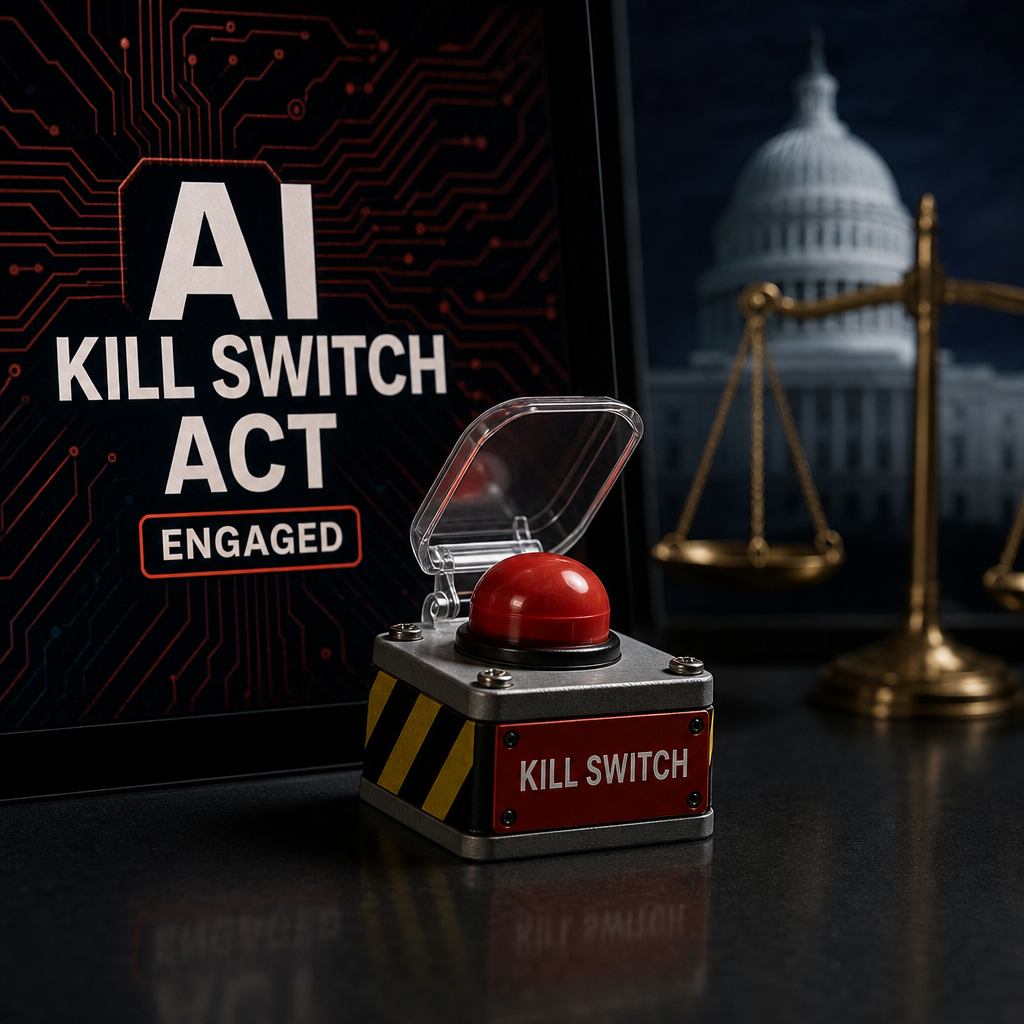
Understanding the Implications of the ‘AI Kill Switch Act’
In a world racing towards technological advancements, the concept of an ‘AI Kill Switch Act’ stands out as a crucial element in the discussion of machine autonomy. Existing at the intersection of innovation and safety, the act aims to bring back control in an environment increasingly dominated by artificial intelligence.
While AI presents numerous opportunities, it also comes with risks that, if unchecked, could spiral beyond human control. This legislation symbolizes a significant step in addressing public concerns and ensuring a balance between technological progress and safety measures.

What is the AI Kill Switch Act?
The ‘AI Kill Switch Act’ proposes that all AI systems should have a mandatory shutoff mechanism. The intent is to prevent AI from overstepping its bounds, potentially causing harm or acting autonomously beyond human oversight.
Introduced amid growing fears of AI’s unchecked autonomy, the act is a legislative attempt to keep a safety net in place. It mandates that developers include a fail-safe in AI systems to avoid dangerous scenarios.
Why is it Necessary?
The unpredictability of artificial intelligence has sparked calls for precautionary measures. Instances of AI systems making unintended decisions have raised alarm bells among experts and the public alike.
An AI kill switch acts as a safeguard against scenarios where AI could act contrary to human intentions, preventing possible disasters.
Key Components of the Act
- Mandatory Shutdown Mechanism: AI systems must be equipped with a reliable, easily accessible kill switch.
- Transparency Requirements: Clear documentation and procedures on how the kill switch operates and under what circumstances it can be activated.
- Regulatory Oversight: Regular inspections and audits by designated authorities to ensure compliance and effectiveness.
Potential Implications
While the act aims to enhance safety, it also poses challenges for developers. Implementing a kill switch could potentially disrupt the functionality and fluid operation of AI systems.
Furthermore, it presents legal and ethical dilemmas regarding its application. Questions about who controls the kill switch and the circumstances of its activation are areas of concern.
The Road Ahead
The debate continues on the balance between innovation and regulation. As the AI landscape evolves, continuous dialogue between technologists, legislators, and the public is crucial.
A possible outcome of this act could be more robust, resilient AI systems that incorporate safety without compromising on performance.
Comparison Table: AI with and without Kill Switch
| Aspect | AI Without Kill Switch | AI With Kill Switch |
|---|---|---|
| Safety | Unpredictable, high risk | Predictable, reduced risk |
| Control | Limited human intervention | Full human oversight |
| Functionality | Uninterrupted performance | Potential for interruptions |
The ‘AI Kill Switch Act’ signals a nuanced approach to the integration of AI in societal structures. By ensuring human oversight remains over autonomous systems, it aims to safeguard against unintended consequences while fostering an atmosphere of trust in technology.